Designing From the Inside Out

The most honest products are not conceived in a boardroom or validated through a focus group. They are built by someone who lived the problem long enough to stop tolerating it. Designing from the inside out means the brief already exists before the project begins. The research is autobiographical. The user is you.
This is where the most honest product design happens: not in response to a client brief, but in response to a need so specific and so consistently ignored that the designer and the user become the same person. The product logic emerges from practice, not assumption.
Language tutoring is one of the most human-centred services that exists. Platforms like Preply and Verbling have built sophisticated infrastructure around the session: matching, scheduling, payment, ratings. What none of them have addressed is everything that happens before the session begins. The preparation. The content curation. The exercise design. The feedback loop. The invisible hour that tutors absorb every week as an accepted cost of the job, with no tool built to reduce it.
bilti was built to solve exactly that.
It Started With a Transition
A year ago I was between projects. A natural pause in the work, the kind that creates space to do things you keep postponing. I went back to teaching languages. I had done it during COVID, briefly and out of necessity, and it had worked well enough to remember. This time it worked better than expected. Spanish, English, Hebrew. Students on Preply and Verbling. What had been a temporary solution became, without planning, a significant part of my professional life.
The problem appeared almost immediately.
The Invisible Workload
Every week, before every session, I was spending between one and two hours preparing. Finding vocabulary appropriate to each student's level. Sourcing audio that was listenable but not trivial. Building exercises that felt coherent rather than assembled. Writing instructions a non-native reader would actually follow. Structuring the whole thing into something I could send.
Then doing it again. For the next student. The following week.
What struck me as a designer was not the volume of the work but its structure. Every piece of preparation lived in a different place. A different tab, a different tool, a different format. I was functioning as editor, copywriter, audio curator, and homework reviewer before ever sitting down to teach. The actual teaching, the conversation, the moment a concept lands, that was the last thing I got to.
When a workflow requires that many context switches before arriving at its core activity, the tool is not serving the user. The user is serving the tool. I had seen this pattern before. I had solved it before. Just never for myself.
I Did What I Always Do
I built something.
The first version was a Word document. Not a prototype, not a wireframe. A document I made for myself to organise what a lesson should contain, in what order, and why. Vocabulary section. Audio reference. Exercises. Homework instructions. A structure I could repeat without reinventing it each time.
This is where the Creative Director instinct is useful and sometimes dangerous in equal measure: the ability to see a system inside a workaround. The document was already a product. It had architecture, sequence, and a clear user need. What it lacked was the scaffolding to make it repeatable at speed, personalised to each student, and deliverable without friction.
The question I kept asking myself was the same one I ask in any design project: who should carry this cognitive load? The tutor, every week, from scratch, or the product, once, so the tutor can focus on what they are actually there to do?
The answer was obvious. The build was not.
Three Problems That Required Three Decisions
As the Word document became a proper product, three distinct failure points in the tutoring workflow became the design brief for bilti.
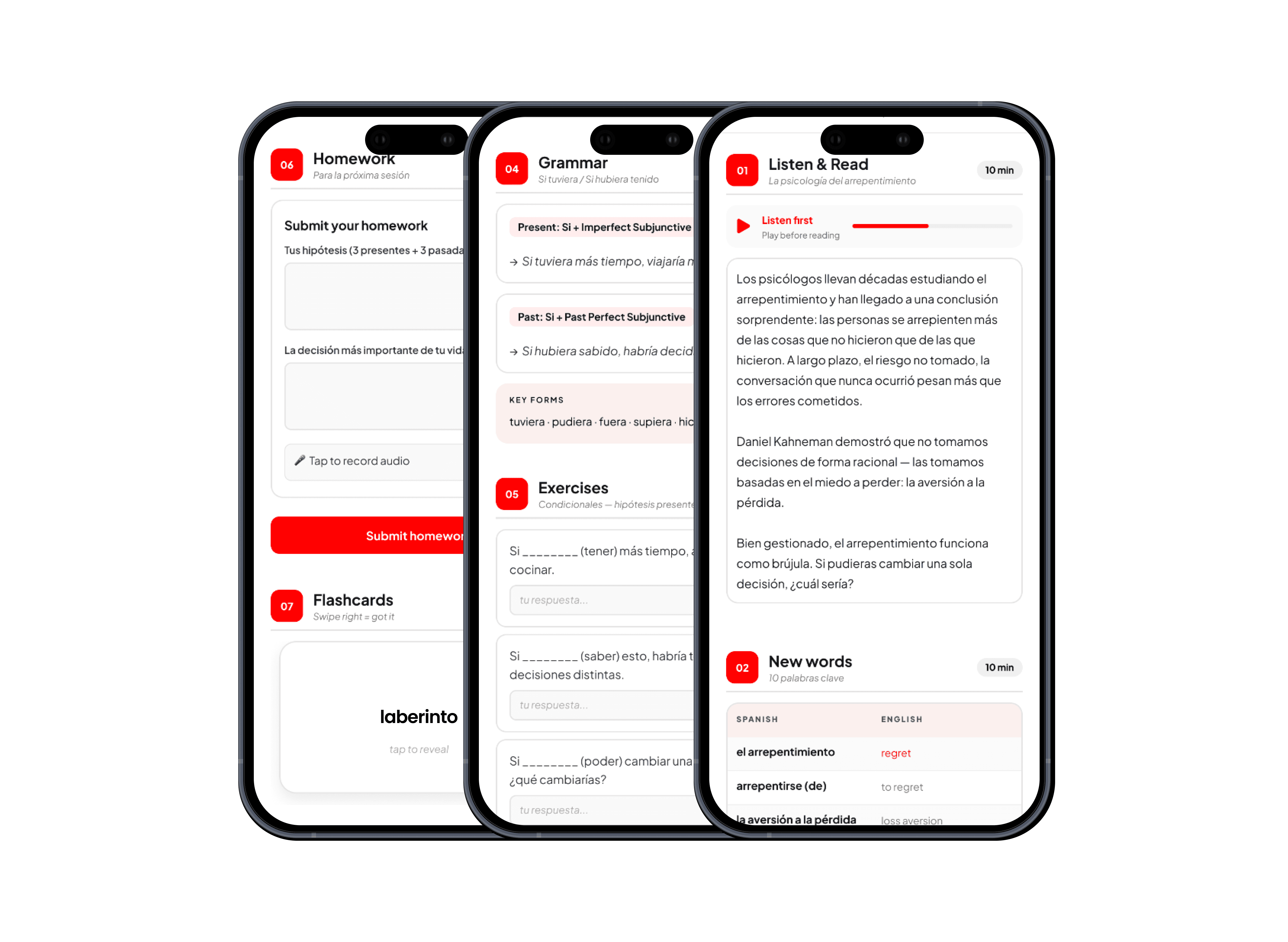
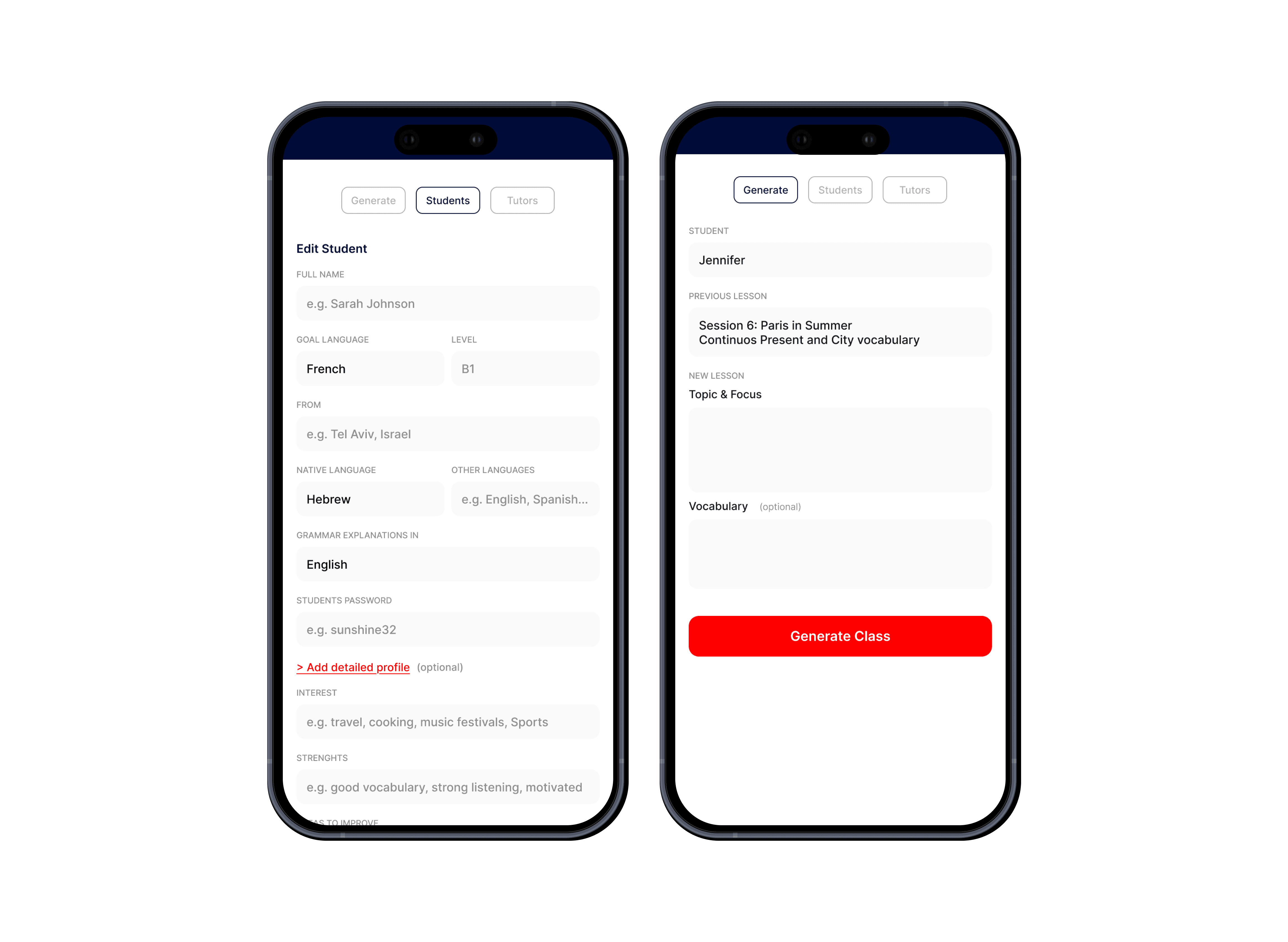
Preparation. The tutor types a topic. bilti generates a complete lesson, vocabulary with audio, structured exercises, material calibrated to the student's level, and delivers it as a single link. Not a draft. Not a set of components to assemble. A ready-to-send session. The output is the product.
Personalisation. Generic tools produce generic content. What makes a lesson work is not the accuracy of the material but its relevance to this specific student: their level, their gaps, their interests. bilti builds around the individual, not around the topic in the abstract. The student is the brief.
Feedback. After each session, students submit homework. Tutors review it, identify errors, write corrections, send responses. Another thirty minutes of administrative work before the next teaching conversation can begin. bilti closes this loop automatically. Mistakes are flagged before the tutor opens the file. The session starts at understanding, not at correction.
One Click Is Not a Feature. It Is a Position.
Most AI tools in education generate pieces. A vocabulary list. A reading text. A set of questions. The user assembles those pieces into something coherent. This is not a workflow improvement. It is a workflow substitution: the same cognitive labour, running through a slightly different interface.
bilti is built on a different assumption: that the unit of value for a tutor is not a component but a complete session. That assumption shapes every product decision. It means the logic of lesson structure has to live inside the product, not inside the tutor's head each time they open a blank document.
This is a harder product to build. It requires decisions about pedagogy, sequence, and format to be made at the design level rather than delegated to the user at the moment of need. It is also the only version of the tool that actually returns time, which was the only thing that ever mattered.
The Disciplines Compound
Creative direction and product design share the same underlying logic: what is the essential unit, how does it scale, where does the user need relief. The medium changes. The thinking does not.
The most overlooked problems in any industry are rarely technical. They are structural. Every tool a language tutor needs already exists. What was missing was a single product that connects preparation, delivery, and feedback into one flow, so the tutor shows up to teach, not to manage.
That is what bilti does. One topic in. One complete, personalised, ready-to-send lesson out. The student works through it, submits homework, and the tutor receives it with mistakes already flagged. The conversation starts where it should: at the language, not the logistics.